Ingredients
MemoHoney ingredients list: what is in each capsule
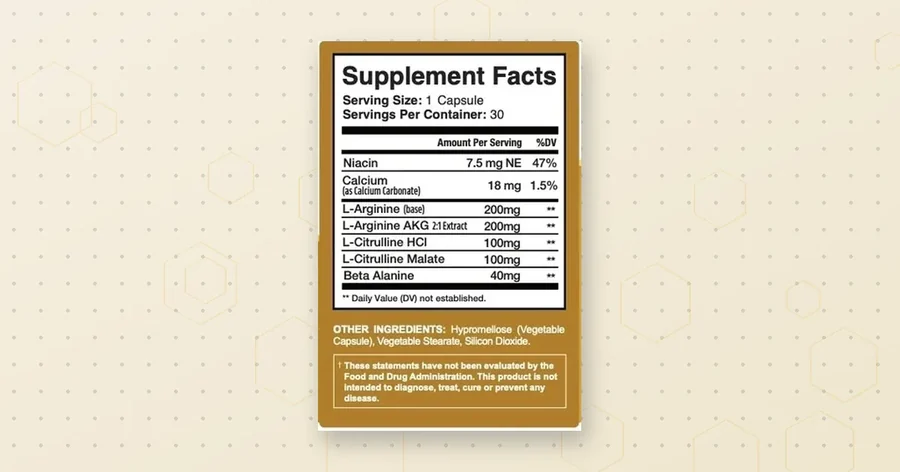
MemoHoney ingredients are seven label rows in five groups: L-arginine (two rows, 400 mg), L-citrulline (two rows, 200 mg), beta alanine 40 mg, niacin 7.5 mg NE and calcium 18 mg. The capsule is hypromellose with vegetable stearate and silicon dioxide. The panel lists no honey, and no proprietary blend.
Written by the MemoHoney label deskUpdated
The list
What are the MemoHoney ingredients?
The MemoHoney ingredients are L-arginine (base), L-arginine AKG 2:1 extract, L-citrulline HCl, L-citrulline malate, beta alanine, niacin and calcium carbonate, all printed in milligrams per capsule (MemoHoney label).
Seven rows make five groups, because arginine and citrulline each appear in two forms. The strip below shows the groups with their label amounts.
- AL-Arginine200 mg + 200 mg per capsule
- CL-Citrulline100 mg + 100 mg per capsule
- BBeta Alanine40 mg per capsule
- NNiacin7.5 mg NE (47% DV) per capsule
- CaCalcium18 mg (1.5% DV) per capsule
The seven rows of the Supplement Facts panel, grouped into five ingredient groups. Amounts are per capsule as printed on the label. Check the panel on your own bottle; if it differs, the bottle wins.
Made of
What is Memo Honey made of?
Memo Honey is made of three amino acids, a vitamin and a mineral, packed in a vegetable capsule.
The amino acids add to 640 mg a capsule. Niacin is vitamin B3, and calcium comes as calcium carbonate. The other ingredients are hypromellose (the capsule), vegetable stearate and silicon dioxide.
| Group | What it is | Per capsule |
|---|---|---|
| L-arginine | An amino acid from protein foods; AKG stands for alpha-ketoglutarate | 200 mg + 200 mg |
| L-citrulline | An amino acid the body turns into arginine | 100 mg + 100 mg |
| Beta alanine | An amino acid muscle cells use to make carnosine | 40 mg |
| Niacin | Vitamin B3; form not stated | 7.5 mg NE (47% DV) |
| Calcium | A mineral, as calcium carbonate | 18 mg (1.5% DV) |
The amino acids
What do the MemoHoney amino acids do?
Arginine, citrulline and beta alanine are amino acids the body already uses, and none has been shown to change memory at the amounts on this label.
L-arginine, 400 mg
Used to make nitric oxide. One 2026 pilot gave 6.4 g a day to older adults with memory problems, and the placebo group improved too (Teotia 2026, oral arginine pilot). See the arginine page.
L-citrulline, 200 mg
We found no human memory trial. Exercise studies used 3 g or more (Trexler 2019, citrulline meta). See the citrulline page.
Beta alanine, 40 mg
28 days in 20 soldiers changed no thinking test (Hoffman 2014, beta-alanine soldiers). See the beta alanine page.
Vitamin and mineral
Why are niacin and calcium in MemoHoney?
The label does not say why niacin and calcium are included; they are a vitamin and a mineral printed as the last two rows.
Niacin at 7.5 mg NE is 47% of the Daily Value, and it is not clear whether it is nicotinic acid or nicotinamide. Nicotinic acid can cause flushing at about 30 to 50 mg (NIH ODS, Niacin). Calcium at 18 mg is 1.5% of the Daily Value; a trial of 1,000 mg with vitamin D found no effect on cognition (Rossom 2012, WHI calcium + D). See niacin and calcium.
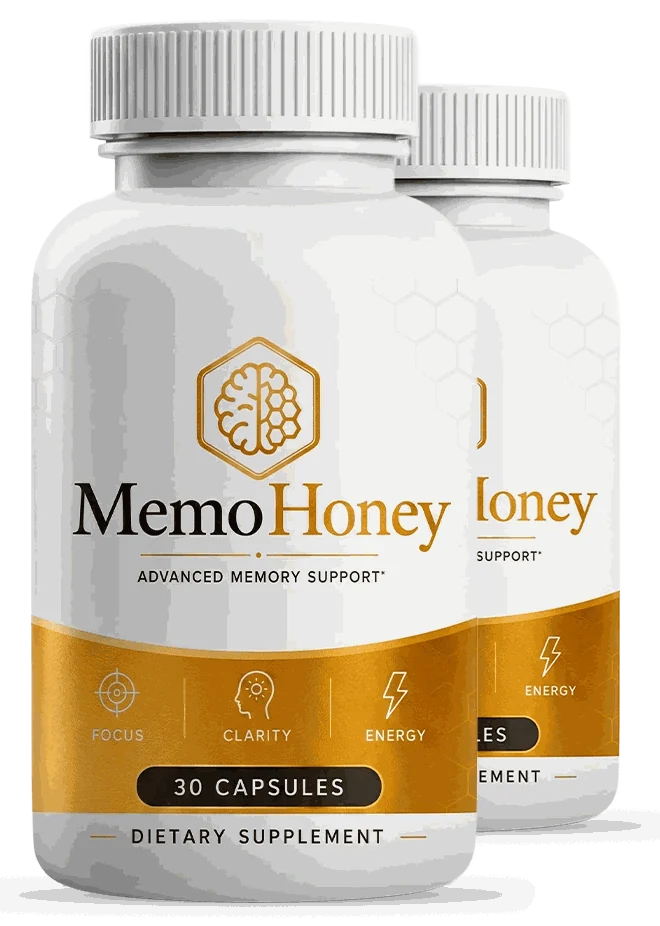
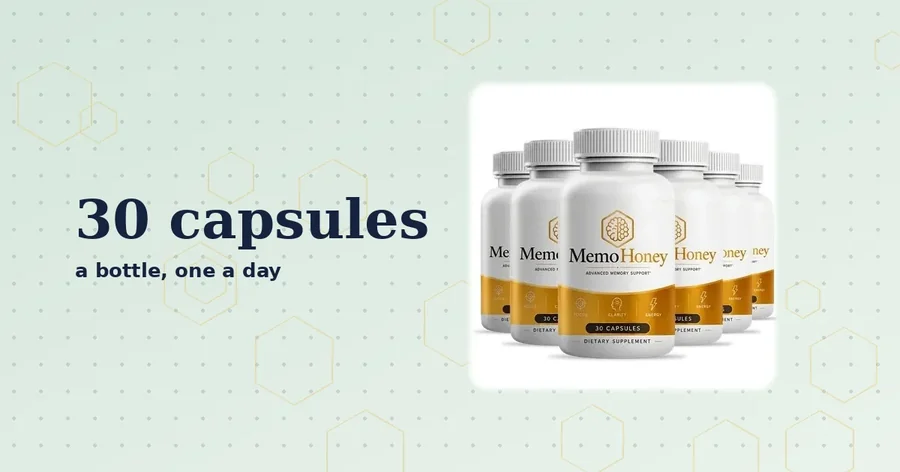
MemoHoney capsules: 30 to a bottleOne capsule a day · 2, 3 or 6 bottles · price and shipping shown at checkout
See the priceAmounts against research
How does each MemoHoney ingredient compare with studied doses?
Each MemoHoney ingredient sits well below the doses researchers used, from about 6% for arginine to far less for the others.
The table gives the label amount, the studied dose, what reviews found and the main caution.
| Ingredient | Label amount per capsule | Amount used in research | What the studies found | Main caution |
|---|---|---|---|---|
| L-Arginine | 200 mg + 200 mg | 6.4 g a day by mouth for 30 days in one small pilot in older adults with measured memory problems; 500 mg per kg by vein in a blood-flow study; up to 30 g a day for 90 days in a safety trial (Teotia 2026, oral arginine pilot) (Reutens 1997, arginine cerebral flow) | A 2026 pilot gave 6.4 g a day of arginine to older adults with memory complaints for 30 days: 16 finished on arginine, 19 on placebo, and the placebo group also improved on memory. A 1997 study that gave arginine by vein (500 mg per kg) raised brain blood flow by 9.5% in 12 people; it ran no memory test and says nothing about a capsule. The label's 400 mg is a small fraction of both. | Can lower blood pressure too far with nitrates, sildenafil-type medicines and blood pressure medicines; can add to blood thinners and diabetes medicines. Not for people after a recent heart attack: in one trial, 6 of 153 patients on arginine died, against none on placebo. Memory problems that are new or getting worse need a clinician. |
| L-Citrulline | 100 mg + 100 mg | No human memory trial of citrulline alone was found; 3 to 9 g a day in exercise and blood pressure trials (Chen 2016, BCAA arginine citrulline) (NIH ODS, exercise supplements) | We found no human trial that tested citrulline or citrulline malate on memory in ordinary adults. The closest item is a 12-athlete trial of a mix of BCAA, arginine and citrulline, where reaction time held up after fatigue; the mix cannot show what citrulline did alone. Exercise reviews used 3 g or more, 15 times the label's 0.2 g. | Short studies up to 6 g a day for 4 weeks reported no adverse effects, but long-term safety has not been assessed well; stomach discomfort occurred in 6 of 41 people in one study. |
| Beta Alanine | 40 mg | 4 to 6 g a day for at least 4 weeks (ISSN, exercise); 28 days in the one cognition test we found (Hoffman 2014, beta-alanine soldiers) (Meftahi 2023, beta-alanine review) | In 20 young soldiers, 28 days of beta-alanine improved shooting accuracy and jump power but not a 2-minute serial subtraction test of thinking (p = 0.844). Reviews of how it might reach the brain through carnosine are speculative. Exercise doses of 4 to 6 g a day are about 100 times the label's 40 mg. | Tingling of the skin (paresthesia) is the one common effect: it starts at single doses of about 800 mg or more, lasts about an hour, and is not harmful. The label's 40 mg is far below that, so studies do not tell us what to expect from it. |
| Niacin | 7.5 mg NE (47% DV) | No trial at the label amount for memory; one food-intake cohort; the RDA for men is 16 mg NE and the upper limit is 35 mg a day (Morris 2004, dietary niacin cohort) (Hegyi 2004, pellagra review) | In 6,158 older Chicago residents, higher niacin from food was linked to lower Alzheimer risk (relative risk 0.3 in the second and top fifths of intake), but that is an association from eating habits, not a trial. Severe niacin deficiency (pellagra) causes dementia-like symptoms, which says little about extra niacin in someone who is not deficient. 7.5 mg NE is 47% of the 16 mg Daily Value. | Nicotinic acid can cause flushing at about 30 to 50 mg or more; high amounts (1,000 to 3,000 mg a day) can harm the liver. The label does not name the form, so it cannot be said whether flushing is likely. |
| Calcium | 18 mg (1.5% DV) | Adults need about 1,000 mg a day from all sources; the memory trial we found used 1,000 mg with vitamin D (Rossom 2012, WHI calcium + D) (Rutjes 2018, Cochrane vitamins) | In 4,143 older women given 1,000 mg of calcium carbonate with vitamin D for about 8 years, there was no difference in dementia, mild cognitive impairment or cognition scores. That is about 55 times the 18 mg on this label, so a capsule with 18 mg adds about 1.5% of a day's calcium and no study ties it to memory. | Calcium carbonate can interact with levothyroxine, some antibiotics and lithium at normal supplement doses; 18 mg is very small, but tell your pharmacist what you take. |
The name
Is there honey in MemoHoney?
No, there is no honey on the MemoHoney ingredient list; the name is a brand name.
The seven panel rows and the other ingredients list none. The hexagon logo draws a honeycomb, which is design. If you avoid honey or bee products for allergy or diet, read the panel on your own bottle.
What is not printed
What does the MemoHoney ingredients list not tell you?
The ingredients list does not tell you the form of niacin, how much arginine the AKG extract holds, who makes the capsules or where each ingredient comes from.
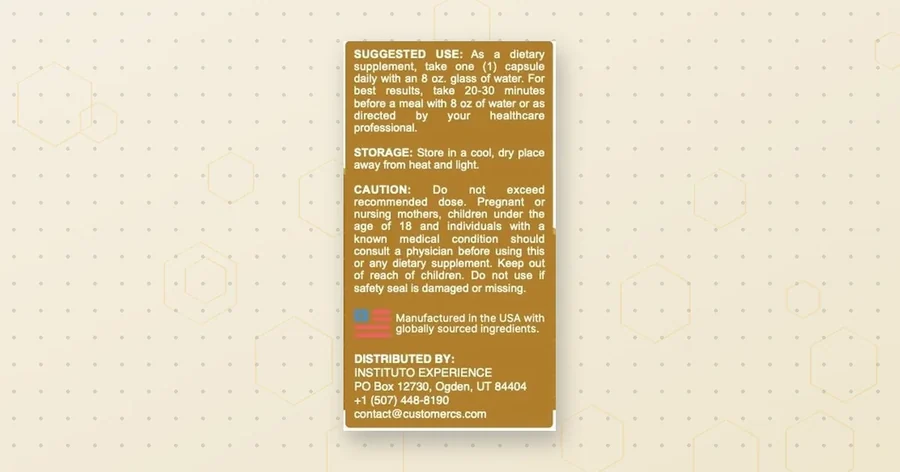
The label says "Manufactured in the USA with globally sourced ingredients" and names a distributor, not a maker. No lab report is published. Ask your doctor or pharmacist first if you take nitrates, sildenafil-type medicines, blood pressure medicines, blood thinners or diabetes medicines, or have had a heart attack: arginine can lower blood pressure too far (Mayo Clinic, L-arginine). Keep taking prescribed medicine.
FAQ
MemoHoney ingredients: common questions
What are the ingredients in MemoHoney?
Per capsule: niacin 7.5 mg NE, calcium 18 mg, L-arginine 200 mg, L-arginine AKG 2:1 extract 200 mg, L-citrulline HCl 100 mg, L-citrulline malate 100 mg and beta alanine 40 mg. Other ingredients are hypromellose, vegetable stearate and silicon dioxide.
Is the MemoHoney ingredient list a proprietary blend?
No. Each of the seven rows prints its own amount in milligrams, so you can see the split. That is a fair strength of the label, though a printed amount says nothing about whether the dose works.
Are the MemoHoney ingredients natural?
The label does not claim that. The amino acids, niacin and calcium are named compounds, and the label says only that ingredients are globally sourced. Whether a source is natural or lab-made is not printed.
Does MemoHoney contain caffeine or stimulants?
None is on the panel. The seven rows are amino acids, niacin and calcium. Beta alanine can cause tingling at single doses near 800 mg, far above the label's 40 mg (Dolan 2019, beta-alanine safety).
Is MemoHoney vegan?
The capsule shell is hypromellose, a plant material, and the panel lists no honey or animal ingredient. The label does not state a vegan certification, and it does not say how the amino acids are made, so check with the seller.
Which MemoHoney ingredient is the largest?
Arginine is the largest, at 400 mg across two rows, and the one with a memory pilot and the main safety cautions. Even so, no study tested that amount. Citrulline, beta alanine, niacin and calcium are smaller or lacked memory trials.
Who wrote this
Written and reviewed by
Pages built from the label, the seller's brief and linked NIH, FDA, CDC, FTC and peer-reviewed sources.
Last updated . Read our editorial standards and how we check reviews. This website is the information site of a USA Authorized MemoHoney Retailer. It is not the manufacturer, and the label names INSTITUTO EXPERIENCE (Ogden, Utah) as the distributor. We earn money when you buy through our order links.
Keep reading
More about MemoHoney
USA Authorized MemoHoney Retailer
Ready to look at MemoHoney?
Check your medicines first, especially nitrates, ED medicines and blood pressure medicines. Then pick a pack: 2, 3 or 6 bottles of 30 capsules. The checkout shows the price, the shipping and the money-back guarantee as printed there.
- Secure checkout on the seller's site
- Money-back guarantee, as printed at checkout
- Shipping shown at checkout